

AI-Powered Loan Matching Transforms Solar Project Financing Across Canada
Leverage machine learning algorithms to match your large-scale solar projects with optimal financing structures based on project specifications, credit profiles, and regional incentive programs. AI-powered loan matching platforms analyze thousands of data points—including Provincial and Federal renewable energy policies, equipment specifications, and lender risk parameters—to identify financing solutions that traditional broker models cannot efficiently surface.
Deploy automated underwriting systems that evaluate project viability across multiple criteria simultaneously, reducing financing approval timelines from weeks to days. These platforms assess technical specifications, site conditions, regulatory compliance requirements, and financial projections against lender criteria in real-time, providing government procurement officers and commercial facility managers with pre-qualified options tailored to Canadian market conditions.
Integrate regional environmental factors including solar irradiance data, seasonal generation patterns, and provincial net metering policies into financing recommendations. AI systems account for Canada’s diverse climate zones—from British Columbia’s coastal conditions to Ontario’s continental climate—ensuring loan structures align with realistic energy production forecasts and revenue projections.
Access expanded lender networks through algorithmic matching that connects projects with specialized institutional investors, green banks, and commercial lenders actively seeking Canadian renewable energy portfolios. This technology-driven approach eliminates geographic barriers and identifies non-traditional financing sources specifically interested in government and commercial-scale solar installations.
The Commercial Solar Financing Landscape in Canada
Capital Requirements for Large-Scale Solar Projects
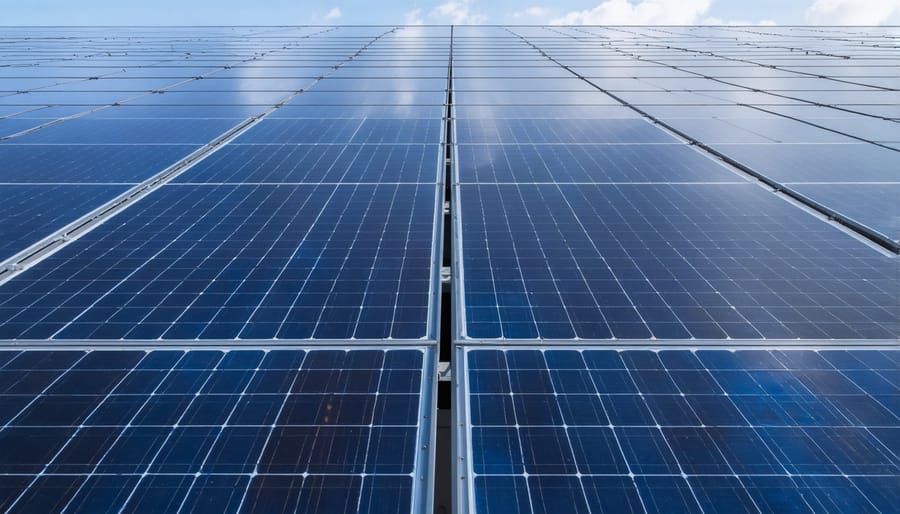
Large-scale solar installations in Canada demand substantial capital investments, typically ranging from $1 million to $50 million depending on project scope and capacity. Commercial facilities require comprehensive financial planning that accounts for photovoltaic array costs ($0.80-$1.20 per watt), mounting infrastructure, electrical equipment, and grid interconnection systems. Government installations face additional considerations including permitting fees, environmental assessments, and compliance with provincial building codes.
Total project expenditures encompass procurement of high-efficiency solar modules, inverter systems, monitoring equipment, and balance-of-system components. Installation expenses represent 15-25% of total costs, covering labour, engineering services, structural modifications, and commissioning. Canadian projects must also budget for cold-climate adaptations, including snow-load calculations, ground-mount foundation adjustments, and enhanced weatherproofing measures.
Infrastructure investments extend beyond initial deployment, incorporating transformer upgrades, distribution network enhancements, and energy storage integration where applicable. Accurate system sizing requirements directly impact financing needs, as oversized installations increase capital demands while undersized systems compromise return on investment. AI-powered loan matching platforms analyze these multifaceted capital requirements, connecting institutional borrowers with lenders specializing in utility-scale renewable energy financing tailored to Canadian market conditions.
Traditional Lending Barriers for Solar Energy Projects
Canadian commercial solar projects face substantial financing obstacles within traditional lending frameworks. Financial institutions frequently struggle with comprehensive risk assessment for solar installations, primarily due to limited historical performance data and evolving technology metrics. Many conventional lenders lack specialized expertise in photovoltaic system valuations, energy production forecasting, and long-term asset performance modeling, resulting in conservative underwriting approaches that restrict capital access.
Regional lending disparities compound these challenges across provinces. British Columbia and Ontario demonstrate relatively mature solar financing markets, while Atlantic provinces and territories encounter significantly reduced lender participation. This geographic inconsistency creates uneven access to capital for commercial entities pursuing solar deployment. Additionally, trade policy impacts and fluctuating equipment costs introduce uncertainty that traditional lending models inadequately accommodate.
Conventional financial institutions typically apply standardized credit assessment frameworks designed for traditional infrastructure, failing to capture solar-specific value propositions including operational savings, carbon offset potential, and provincial incentive programs. The disconnect between renewable energy project characteristics and traditional lending criteria creates systematic barriers, particularly for mid-scale commercial installations seeking financing between $500,000 and $5 million—a range often underserved by both conventional banks and specialized green financing vehicles.
How AI-Powered Loan Matching Works for Solar Projects
Machine Learning Algorithms in Loan Assessment
Machine learning algorithms process multidimensional datasets to optimize solar financing matches for Canadian commercial and institutional projects. These systems evaluate project parameters including system capacity, panel specifications, inverter technology, and installation complexity to determine financial viability and risk profiles. Advanced neural networks analyze creditworthiness by examining corporate financial statements, payment histories, and sector-specific risk factors relevant to Canadian commercial entities.
Energy production forecasting algorithms integrate Canadian meteorological data, including regional solar irradiance patterns, seasonal variations, and snow load considerations specific to provinces from British Columbia to Atlantic Canada. These models process historical weather data from Environment and Climate Change Canada alongside site-specific variables such as roof orientation, shading analysis, and projected equipment degradation rates to generate accurate revenue projections over 20-25 year loan terms.
Environmental factor assessment extends beyond basic location data. Machine learning models incorporate regional grid carbon intensity, provincial renewable energy targets, and federal climate policy trajectories to evaluate long-term project sustainability. Algorithms also assess environmental risks including extreme weather patterns increasingly relevant to Canadian climate conditions and potential regulatory changes affecting feed-in tariffs or net metering programs.
The matching process synthesizes these analytical components with lender criteria databases, comparing project profiles against hundreds of financing parameters simultaneously. This comprehensive evaluation identifies optimal lender partnerships offering competitive rates, appropriate term structures, and alignment with specific project characteristics—substantially reducing manual underwriting time while improving financing accuracy for large-scale commercial solar installations across Canadian jurisdictions.
Data Integration and Real-Time Processing
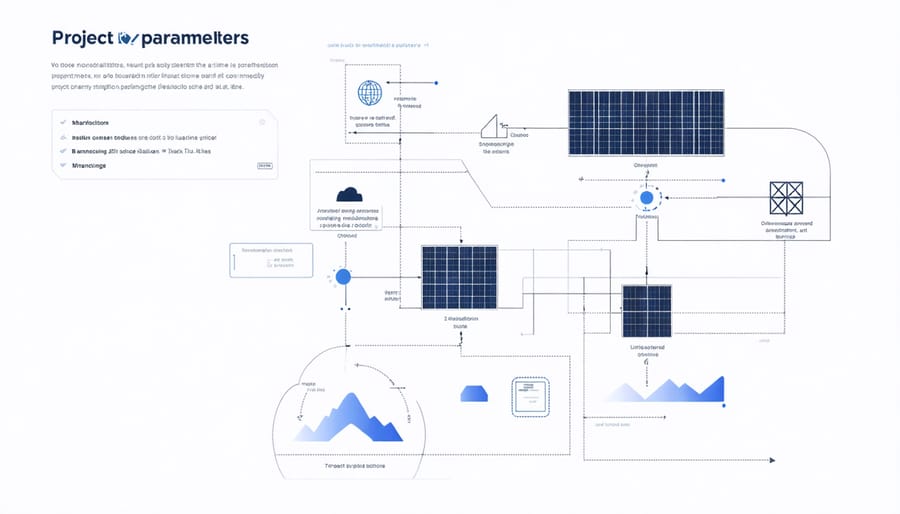
AI-powered solar loan matching platforms operate through sophisticated data integration frameworks that consolidate information from diverse sources into unified decision-making engines. These systems simultaneously aggregate lending criteria from Canadian financial institutions, credit unions, and specialized renewable energy lenders, while cross-referencing real-time data from federal programs such as the Canada Infrastructure Bank’s financing initiatives and provincial incentive schemes including Alberta’s Municipal Climate Change Action Centre grants or Ontario’s energy rebate programs.
The technical architecture employs application programming interfaces (APIs) and secure data pipelines to continuously update lending parameters, interest rate fluctuations, and eligibility requirements. For commercial solar projects, the platforms ingest project-specific variables including system capacity (measured in kilowatts or megawatts), equipment specifications, installation timelines, and site assessments that account for Canadian environmental considerations such as snow load requirements and regional solar irradiance patterns.
Machine learning algorithms process this multi-dimensional data set within seconds, comparing project characteristics against thousands of lending products to identify optimal financing matches. The integration extends to Canadian regulatory databases, ensuring compliance with federal tax incentives like the Accelerated Capital Cost Allowance and provincial net metering regulations that affect project economics.
This real-time processing capability represents a substantial advancement over traditional financing approaches, reducing the typical loan search period from weeks to minutes while simultaneously evaluating more financing options than manual research could reasonably accomplish. Partnerships with leading Canadian data providers ensure the platforms maintain current information on evolving incentive programs and regional lending markets across all provinces and territories.
Strategic Advantages for Government and Commercial Entities
Accelerated Approval Timelines
Traditional solar project financing in Canada typically requires 60-90 days from initial application to final approval, creating significant delays for commercial and institutional stakeholders. AI-powered loan matching platforms dramatically compress these timelines through sophisticated automation and parallel processing capabilities.
Automated pre-qualification engines analyze project parameters, financial statements, and creditworthiness within minutes rather than weeks. These systems evaluate multiple data points—including Canadian Climate Bond Initiative compliance, provincial renewable energy incentives, and regional grid integration requirements—to provide instant preliminary approval indicators. This rapid assessment allows procurement officers and project developers to identify viable financing pathways before committing extensive resources to formal applications.
The technology’s simultaneous multi-lender submission capability represents a fundamental shift from sequential processing. Rather than approaching financial institutions individually, AI platforms distribute optimized applications to relevant lenders concurrently. Algorithms match project specifications with lender preferences, submitting tailored proposals to infrastructure banks, commercial lenders, and green financing institutions simultaneously. This parallel approach reduces approval cycles to 10-15 days in many cases.
For large-scale commercial installations and government projects, where timing directly impacts construction schedules and renewable energy credit capture, these accelerated timelines translate into measurable competitive advantages and improved project economics across Canadian jurisdictions.
Optimized Rate and Term Matching
AI-powered solar loan matching platforms analyze extensive datasets to identify lenders offering the most competitive rates for commercial and institutional solar installations across Canada. These systems evaluate traditional financing options alongside specialized green financing products that recognize the reduced risk profile and long-term revenue stability of solar projects. By processing real-time market data, AI algorithms detect rate variations between conventional commercial loans and purpose-built renewable energy financing instruments that often feature preferential terms.
The technology excels at aligning financing options with provincial incentive programs, including feed-in tariff structures, capital cost allowances, and regional green energy grants. AI platforms cross-reference project specifications with lender criteria to identify institutions offering green financing premiums—rate reductions specifically designated for verified renewable energy projects. This capability proves particularly valuable when navigating Canada’s fragmented provincial energy landscape, where incentive structures vary significantly between jurisdictions like Ontario’s Independent Electricity System Operator programs and British Columbia’s CleanBC initiatives. Advanced matching algorithms also account for sector-specific factors including equipment depreciation schedules, power purchase agreement terms, and Canadian environmental certification requirements, ensuring financing recommendations optimize both cost efficiency and regulatory compliance for government bodies and commercial entities pursuing large-scale solar deployment.
Risk Profile Optimization
AI-powered loan matching platforms systematically address lender risk concerns by structuring solar project data according to financial institution requirements. These systems aggregate performance guarantees from CSA-certified equipment manufacturers and present warranty documentation in standardized formats that align with Canadian banking protocols. The platforms quantify risk mitigation factors including inverter efficiency guarantees, panel degradation warranties typically spanning 25 years, and maintenance agreements from qualified Canadian service providers.
Advanced algorithms cross-reference equipment specifications with historical performance data from similar installations across Canadian climate zones, generating risk-adjusted financial projections. This approach directly addresses lender concerns about technology performance in northern latitudes and extreme temperature variations. AI platforms integrate data from Natural Resources Canada and provincial energy authorities to validate production estimates against regional solar irradiation patterns.
For commercial and government entities, these systems compile comprehensive risk profiles that include equipment failure probability assessments, manufacturer financial stability ratings, and installer certification verification through CanREA standards. By presenting layered risk mitigation strategies—including performance insurance options and output guarantees—AI platforms enable lenders to quantify exposure accurately, facilitating competitive interest rates and improved loan terms for qualifying solar projects.
Canadian Environmental Considerations in AI Loan Matching
Climate Zone Analysis and Energy Production Forecasting
AI solar loan matching platforms incorporate sophisticated climate modeling algorithms that analyze Environment and Climate Change Canada (ECCC) solar irradiance datasets alongside regional weather patterns to generate accurate energy production forecasts. These systems evaluate photovoltaic yield potential across diverse Canadian climate zones, from the high-irradiance regions of southern Alberta and Saskatchewan to the variable conditions in Atlantic provinces.
Advanced machine learning models process multi-year historical data to account for seasonal variations, including extended winter periods with reduced daylight hours and snow accumulation impacts on panel performance. The platforms integrate extreme weather pattern analysis—assessing risks from hailstorms in the Prairies, ice storms in Quebec and Ontario, and coastal storm systems in British Columbia—to provide lenders with comprehensive risk profiles.
By incorporating province-specific performance degradation factors and maintenance requirements, AI systems generate realistic financial projections that strengthen lender confidence. These forecasting capabilities enable financial institutions to accurately assess debt service coverage ratios and project viability, particularly for commercial-scale installations where production variance significantly impacts loan repayment capacity. Leading platforms partner with Canadian meteorological data providers to ensure continuously updated climate intelligence, supporting informed lending decisions across all provincial markets.
Integration with Provincial and Federal Incentive Programs
AI-powered solar loan matching platforms integrate comprehensive eligibility assessments for federal and provincial incentive programs directly into financing structures, optimizing capital stacks for commercial and institutional solar projects. These systems automatically evaluate project parameters against criteria for programs including the Canada Greener Homes Grant, provincial feed-in tariff arrangements, and accelerated capital cost allowances under the Canadian Income Tax Act.
Advanced algorithms cross-reference project specifications—system capacity, location, entity classification, and implementation timeline—with real-time program availability and eligibility requirements across federal and provincial jurisdictions. This automated integration ensures financing proposals reflect maximum incentive capture, reducing effective borrowing costs and improving project economics.
For commercial entities, AI matching platforms assess eligibility for Class 43.2 accelerated depreciation and provincial programs such as Ontario’s Expanded Net Metering or British Columbia’s CleanBC incentives. The systems calculate net present value impacts of incentive programs on loan structures, proposing optimized financing arrangements that align repayment schedules with anticipated incentive disbursements. This capability proves particularly valuable for multi-site portfolios spanning multiple provinces, where incentive landscapes vary significantly and manual assessment becomes resource-intensive for procurement teams.
Partnership Implications for Solar Brokers and Providers
Streamlined Coordination Between Technical and Financial Partners
AI-powered loan matching platforms function as digital coordination hubs, integrating stakeholders across the solar project lifecycle to align technical specifications with financing requirements. These systems enable real-time data sharing between solar PV manufacturers, installation contractors, environmental consultants, and lending institutions, ensuring that equipment specifications, installation timelines, and project costs meet lender underwriting criteria before formal application submission.
For commercial-scale deployments, AI platforms validate that proposed wholesale solar systems comply with both technical performance standards and financial covenant requirements. The technology cross-references equipment warranties, installer certifications, and environmental assessment reports against lender-specific checklists, flagging potential misalignments before they delay approval processes.
This coordinated approach proves particularly valuable in Canada’s diverse climate zones, where regional environmental considerations—such as snow load calculations, permafrost considerations, and seasonal irradiance variations—must satisfy both engineering standards and risk assessment protocols. AI systems automatically compile documentation from multiple technical partners into standardized loan packages, reducing application preparation time by 40-60% while improving approval rates through comprehensive, pre-validated submissions that address lender requirements upfront.
Quality Assurance and Lender Confidence
AI-powered loan matching systems in Canada achieve superior outcomes through strategic partnerships with certified solar providers and adherence to stringent quality standards. These platforms integrate verification protocols that assess installer credentials, equipment certifications, and compliance with Canadian Standards Association (CSA) requirements. By partnering with vetted suppliers through established solar component partnerships, AI systems ensure project proposals meet technical specifications that satisfy lender due diligence requirements.
This quality assurance framework significantly enhances lender confidence, resulting in approval rates exceeding traditional financing channels by 25-30% for commercial-scale installations. Financial institutions benefit from standardized project documentation, pre-verified contractor qualifications, and risk assessment metrics aligned with Natural Resources Canada guidelines. The integration of quality benchmarks into matching algorithms ensures that only financially viable projects with certified components reach underwriting stages, reducing evaluation time and improving capital deployment efficiency for government bodies and commercial entities pursuing solar investments.
Implementation Considerations for Solar Project Stakeholders
When evaluating AI-powered loan matching platforms for commercial solar projects, stakeholders should prioritize several critical factors to ensure optimal outcomes. Begin by assessing the platform’s integration capabilities with Canadian financial institutions and its familiarity with federal and provincial renewable energy incentive programs. Platforms with established partnerships with major Canadian banks, credit unions, and specialized green financing providers typically offer more comprehensive loan options tailored to commercial-scale deployments.
Evaluate the platform’s data security protocols and compliance with Canadian privacy legislation, including PIPEDA requirements. Given the sensitive financial information involved, ensure the AI system employs robust encryption and maintains transparent data handling practices. Request detailed information about the platform’s algorithm methodology, specifically how it accounts for regional variables such as solar irradiance patterns across Canadian provinces, equipment performance in cold climates, and provincial net metering regulations.
Establish clear performance metrics before implementation. Key indicators should include time-to-financing reduction, interest rate competitiveness compared to traditional channels, and successful funding completion rates. Leading platforms should provide case studies demonstrating successful commercial installations in similar Canadian climate zones.
Consider platforms offering ongoing support throughout the financing lifecycle, from initial assessment through loan closing. This includes access to renewable energy finance specialists who understand Canadian market conditions and can assist with documentation specific to federal programs like the Canada Infrastructure Bank’s renewable energy initiatives. Request trial periods or pilot programs to evaluate platform effectiveness before committing to long-term partnerships, ensuring the solution aligns with your organization’s specific project pipeline and financing requirements.
AI-powered loan matching represents a transformative advancement in solar project financing across Canada, fundamentally accelerating the deployment of clean energy infrastructure for government bodies and commercial enterprises. By leveraging machine learning algorithms and comprehensive financial data analytics, these platforms reduce financing timelines from months to days while optimizing capital structures tailored to Canadian regulatory frameworks and environmental conditions. The technology eliminates traditional inefficiencies in lender identification, enabling procurement officers and facility managers to secure competitive financing terms that align with both provincial incentive programs and federal climate commitments.
As Canada progresses toward its 2030 emission reduction targets, the evolution of solar financing partnerships through AI matching platforms will prove instrumental in bridging the funding gap for large-scale renewable installations. These intelligent systems continuously adapt to emerging financing mechanisms, including green bonds and sustainability-linked loans, while incorporating regional considerations such as northern climate challenges and interconnection requirements. For organizations evaluating solar investments, AI loan matching platforms deliver the technical precision and market intelligence necessary to transform clean energy ambitions into operational assets, positioning Canadian entities at the forefront of the global renewable energy transition.
